Brazil is listed with 127/220V facility-dependent voltage references, 60Hz, and Type C, Type N in the reviewed travel references. These figures describe a destination profile, not the outlet in your room. Source differences or regional conditions require extra confirmation before connecting a single-voltage device.
Before plugging in
The reference lists several plug families. That is a list of observed formats across sources, not a guarantee that every building has them. Ask the property which voltage is present at the particular outlet you will use. Do not infer a Brazilian building voltage from its city name.
Brazil voltage, frequency and plug types
| Voltage reference | 127/220V |
|---|---|
| Voltage mode | mixed facility |
| Frequency | 60Hz |
| Plug families | Type C, Type N |
| Voltage evidence | manufacturer references |
| Frequency evidence | reference agreement |
| Plug evidence | manufacturer and safety references |
| Profile review | reference data with caveats |
| Territory of | Not applicable |
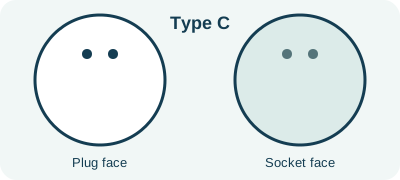
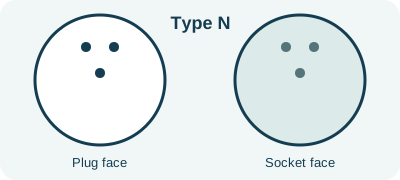
Illustrations show broad family shapes only. They are not dimensioned drawings or a fit test.
A plug letter identifies a shape family. It does not establish the supply voltage, the exact subvariant, the condition of the wall socket, or a working protective earth. Nominal values can differ from the actual supply at a particular property.
What changes for a US traveler?
A US appliance marked 120V only does not cover every 127/220V reference candidate. Do not use a plug adapter to bridge that electrical mismatch. The listed plug families differ from common US A/B plugs. Investigate a correctly rated adapter for the actual socket, with protective earth if your appliance requires it. The reference frequency includes 60Hz; a US 60Hz-only appliance still needs the other electrical checks.
- Different outlets or facilities can have different voltage; ask about the specific one you will use.
- The plug family has country-specific variants; check the exact pin and rating standard.
Why some charts disagree
The values below are retained as a research conflict, not silently averaged into a new national standard. An outlet-specific answer matters most for a single-voltage device.
| Field | Values reported | References |
|---|---|---|
| voltage | [[127], [127, 220]] | Bel Fuse , Electrical Safety First , MAG Kabel |
| plug types | [["C", "N"], ["N"]] | Bel Fuse , Electrical Safety First , MAG Kabel |
Brazil research note
Both 127V and 220V exist in the country references. A broad-input device can cover both voltage candidates on that field, but a city name cannot choose the voltage of an individual outlet. Type N 10A and 20A variants also differ.
Check your device label
Find the INPUT line on the item that actually connects to AC power. Confirm its voltage range includes the local supply, its frequency rating includes the local frequency, and its plug and grounding requirements are met. A USB output rating such as 65W is not the AC input rating.
| Device | Check before use |
|---|---|
| Phone and tablet chargers | If the actual charger says INPUT 100–240V 50/60Hz, the listed 127/220V and 60Hz values are inside those two ranges. Check its wall plug and USB profile separately. |
| Laptop supplies | Inspect the brick and detachable cord. A Type C/N country listing does not verify a Class I earth path in your room. |
| Cameras and small chargers | Read the battery charger’s AC INPUT, not the camera body. A 120V-only label cannot be cleared for 127/220V without a maker-approved solution. |
| Hair dryers and heated tools | A US 120V-only heating appliance is outside at least one 127/220V candidate; a shape adapter is not a converter. |
| Medical and CPAP devices | Ask the maker and care team to compare the exact power supply with 127/220V and 60Hz; plan a backup rather than relying on a country-level safe-use verdict. |
Screen your device for Brazil · Compare from your home country
What adapter type should you look for?
Start with an adapter that explicitly accepts your device’s actual plug and has an output plug matching the outlet shown by your accommodation. Check the adapter’s AC current rating, permitted appliances and earth continuity. A universal adapter can have several pins yet lack protective earth. A shape adapter cannot step voltage up or down.
For Brazil, research Type C or Type N. Do not buy solely from this country-level listing; ask the property about the exact socket variant first.
- Dedicated destination head: investigate one that names the exact wall socket variant and your device plug.
- Grounded route for Class I equipment: require documented protective-earth continuity from the wall through the adapter.
- Documented universal model: useful for several stops only when every required variant and the AC load are supported.
Travel questions for Brazil
Will a US plug connect directly in Brazil?
The listed Type C, Type N families differ from common US A/B. Look for a device-to-wall adapter for the actual room socket, not a country-name guarantee.
Can I use a device marked 120V only?
Not from the 127/220V reference alone. At least one candidate is outside a 120V-only label; ask the property and product maker before connecting it.
What should I confirm with the property?
Ask for the voltage and a photo or exact name of the outlet you will use. The reference data with caveats research status and Type C, Type N listing do not verify every room or a working protective earth.
Evidence and limits
Voltage references: Panasonic . Frequency references: Bel Fuse , Electrical Safety First , MAG Kabel , MENNEKES , Panasonic . Plug references: Bel Fuse , Electrical Safety First , MAG Kabel , MENNEKES , Panasonic . Reviewed 2026-11-01; no on-site outlet or product test was performed.
The research record marks this profile as reference data with caveats. If sources disagree, the screening tool requests local confirmation rather than treating a nominal reference as a safety certificate. Report a correction
Continue planning
United States · Canada · Mexico · Puerto Rico · Bahamas · See the region